I spent 20 years with the Miami Police Department — came up through patrol, finished my career as a detective. For all of it, when a parent asked me how to keep their kid safe around guns, I gave the department answer. Lock it up. Teach them the four rules. Tell them: stop, don't touch, leave the room, tell an adult.
Good advice. True advice. I'd say it at school events and open houses, hand out the pamphlet, shake the dad's hand. Everybody went home feeling covered.
I need to tell you what I know now, because I owe about a thousand parents a correction.
The test kids fail after they pass the quiz
Researchers have run a version of this experiment for years — the one every parent should know about and almost none have heard of. Teach children the safety rules until they can recite them cold. Then leave them in a room where they find a (disabled) gun, with a hidden camera running.
The kids who'd been told the rules picked it up anyway. Some checked whether anyone was watching first — which tells you they knew the rule, and it didn't stop their hands. The kids who did it right were the ones who had physically rehearsed the safe response, over and over, until it wasn't a decision anymore. Behavioral skills training, the researchers call it. Reps, we called it.
That finding didn't surprise me, and here's why: it's exactly how we trained. Nobody qualifies with a firearm from a rulebook. Not one rookie I ever worked a shift with learned safe handling from a lecture. You learn it the way you learn anything your hands have to do under pressure — you do it, correctly, hundreds of times, until the right motion is the only motion you've got.
We would never certify an adult on rules alone. And then we send seven-year-olds out into the world with… a poster.
"It's locked up" covers less than you think
The second thing I got wrong took longer to see. When I told parents "lock it up," I was answering for their house. Your safe is bolted to your floor. Your kid isn't.
Roughly one in three American homes has a firearm, and plenty of them aren't stored the way yours is. Your kid will eventually stand in some of those houses — the sleepover, the cousin's place, a garage you've never seen — without you in the room. The lock protects one address. A lecture gets left at the door.
The only thing that goes with a child to every house on the block is the reflex in their own hands.
So keep the safe. That part was never wrong. It was just never the whole answer. The whole answer is both: lock the gun, and build the reflex.
What the fix would have to be
Once you accept that reps are the mechanism, you can write the spec for the fix on an index card. It would have to run like the real thing — the loading, the racking, the checking — or a kid's hands would learn a toy instead of a discipline. It would have to be safe enough to run in a living room a hundred times, because a hundred times is how kids learn anything. And a kid would have to want to pick it up on his own, because a drill that feels like homework gets run twice.
I didn't think that existed. Toy guns are built backwards for this — they look real and do nothing. The look is the only dangerous part, and the doing is the only teaching part.
Then somebody in my comments recommended a toy
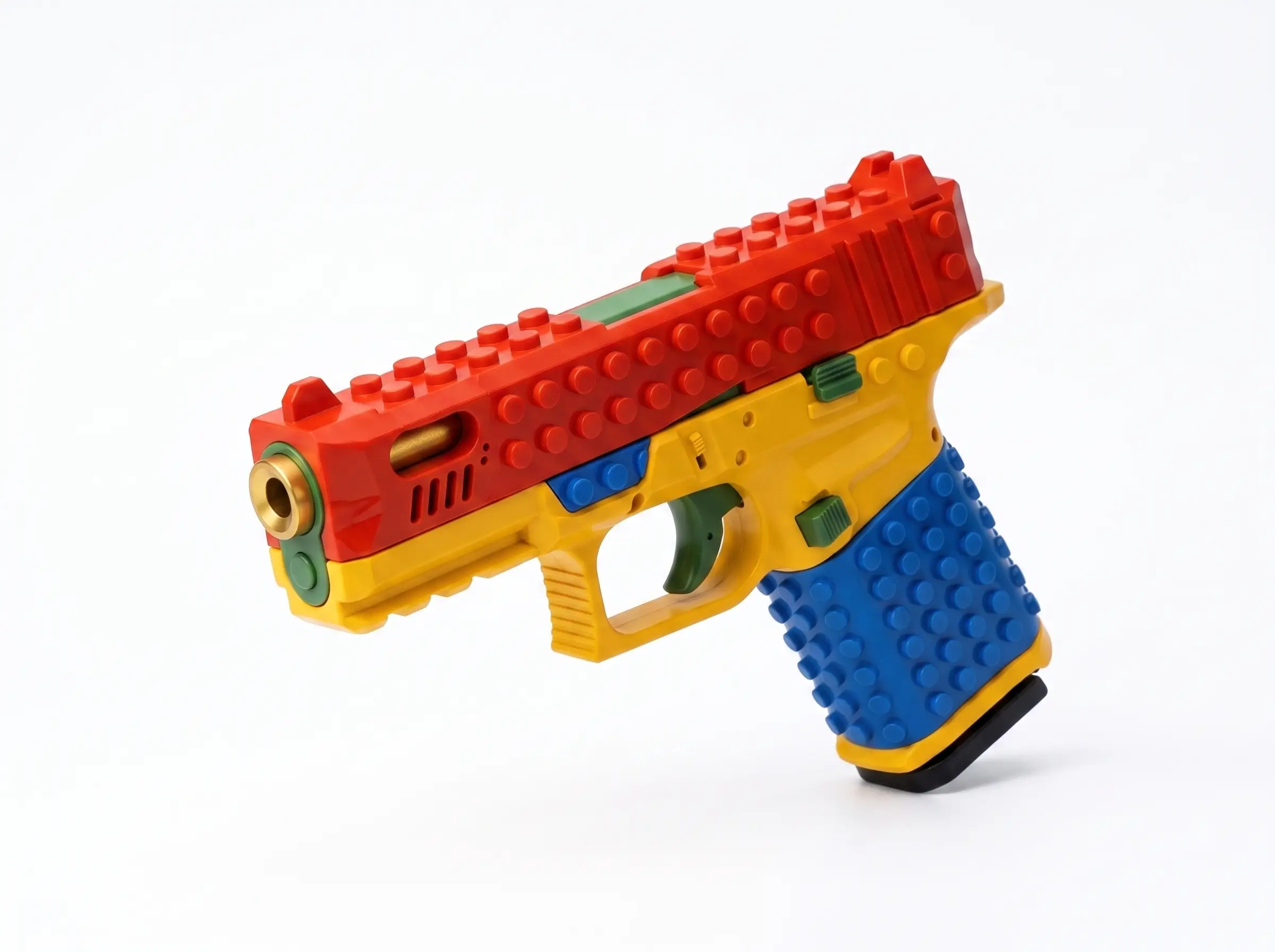
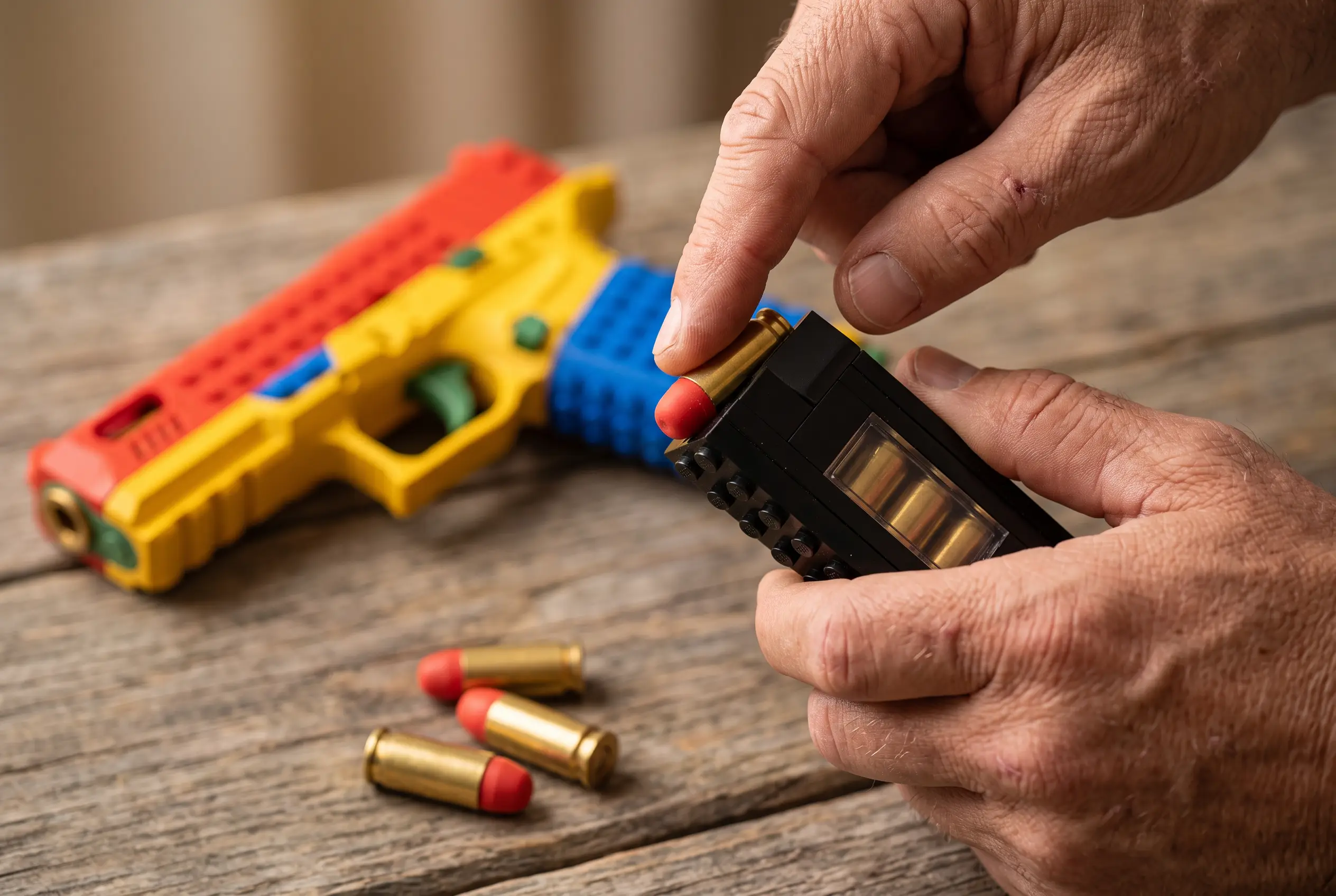
After I retired I started posting on Facebook about how I teach my own kids — the drills, the four rules, the reps. And one name kept showing up under those posts: parents telling me to look at some brick-built trainer their kids ran drills on. It's called The BlockBlaster™. From across the street it's unmistakably a toy — bright building-block bricks, red and yellow and blue, the opposite of realistic. I'll be honest: I assumed it was junk.
Then I ran the cycle.
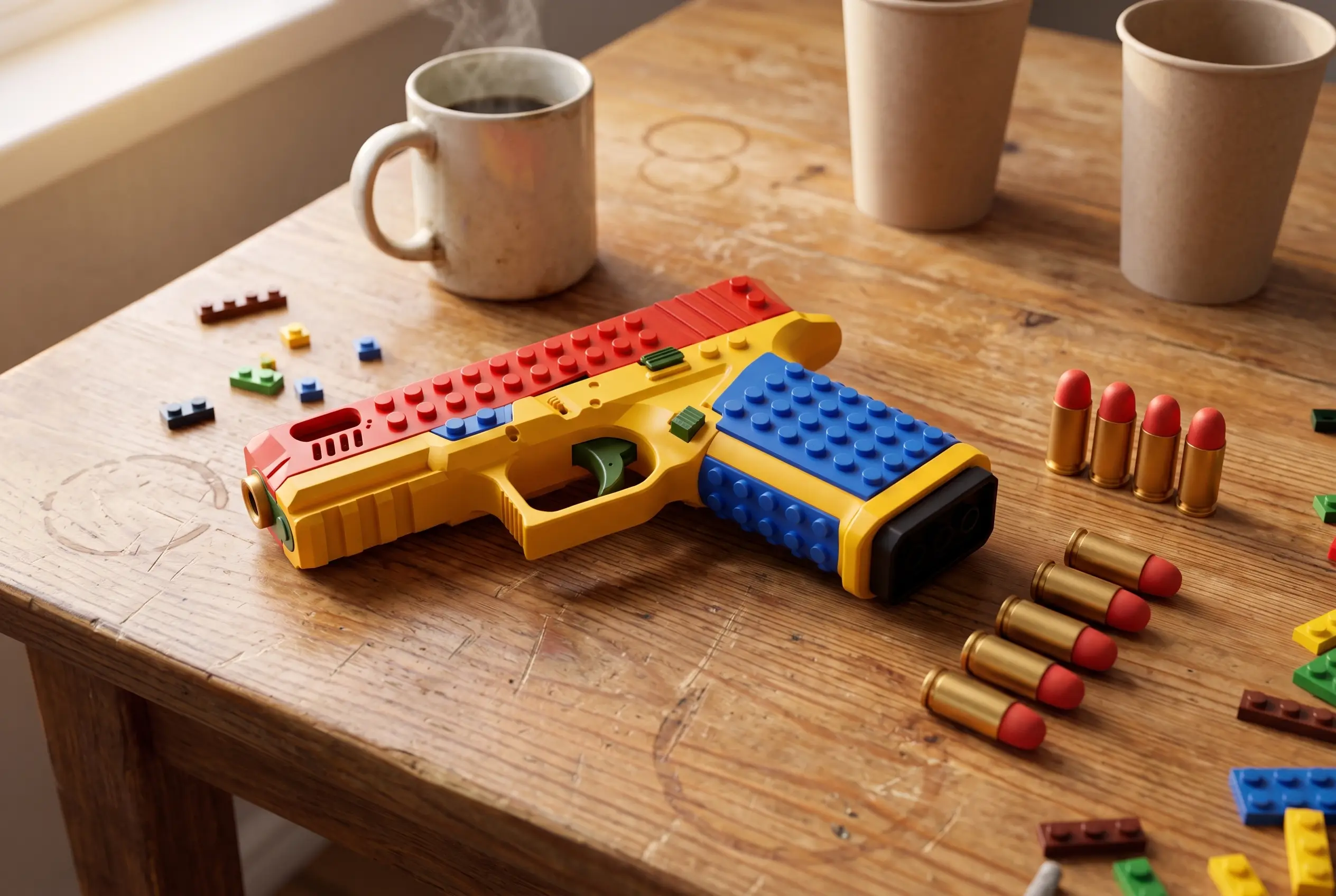
You press six soft rubber rounds into six spring-loaded casings. Load them into a real detachable magazine — witness window, floorplate, the works. Seat it with a palm tap. Rack the slide. Every pull of the trigger sends the soft dart, kicks the spent casing out of the right-side port, and chambers the next one — and after the sixth, the slide locks open on an empty chamber. The kid looks into it, sees it's empty, says "clear," and drops the mag to reload.
That's the entire manual of arms. Load, rack, fire, eject, lock back, check, reload. A child can run fifty honest reps of it in an afternoon — and never once feel like he's being taught.
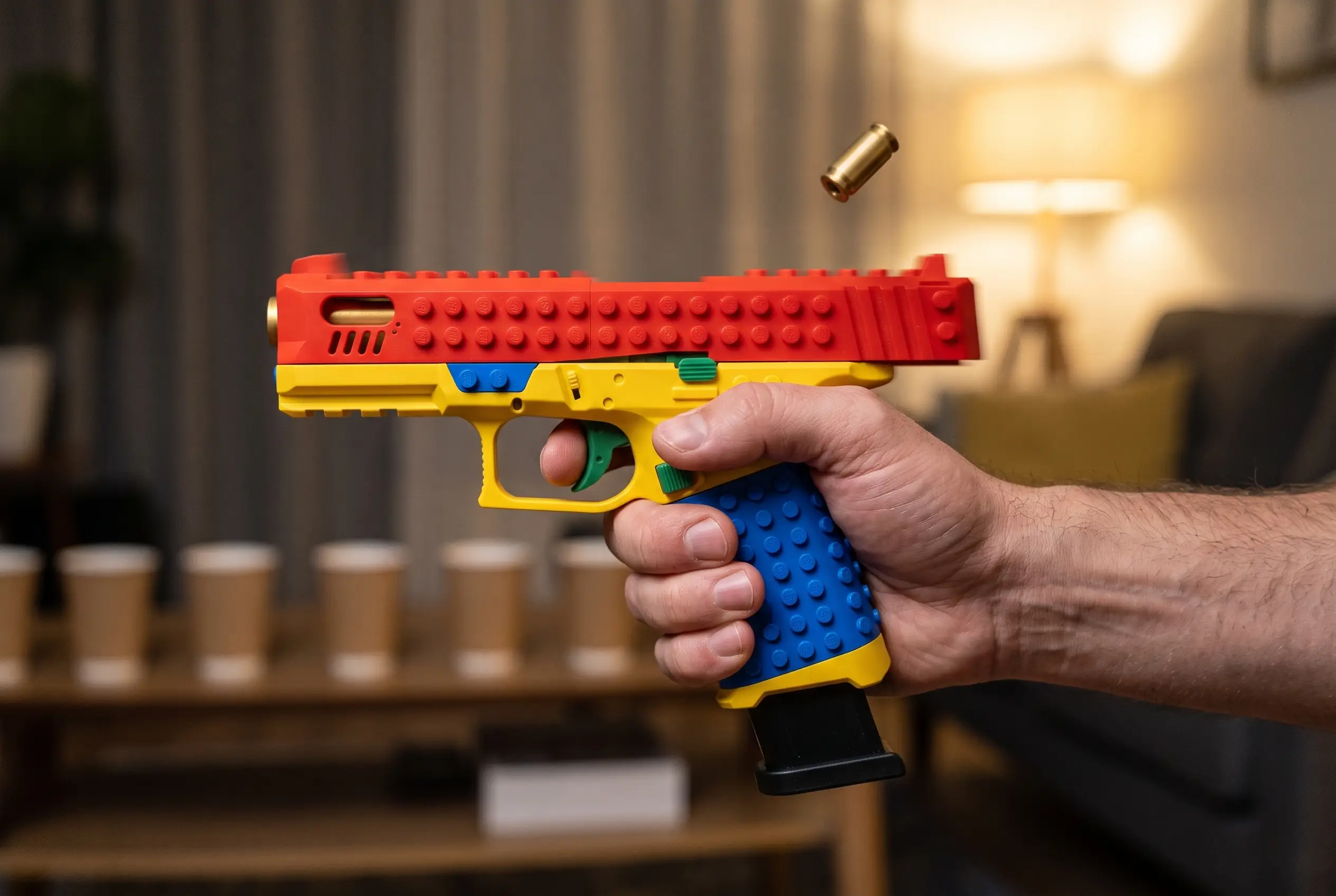
Here's the inversion that sold me, as a man who spent 20 years around the real thing: this toy is realistic in the only place realism teaches — the function — and toy-like in the only place realism scares people — the look. Nobody mistakes it for a firearm. And the habits it builds are the real ones: muzzle where it should be, finger indexed along the frame until sights are on target, check the chamber, count your rounds, police your brass.
It's 100% a toy and can never be anything else — all-brick construction, spring power, soft tips, kid-safe speeds. It knocks over paper cups. It will not mark a wall. My kids' drywall and I can both confirm.
See what comes in the box ↓What happens around week two
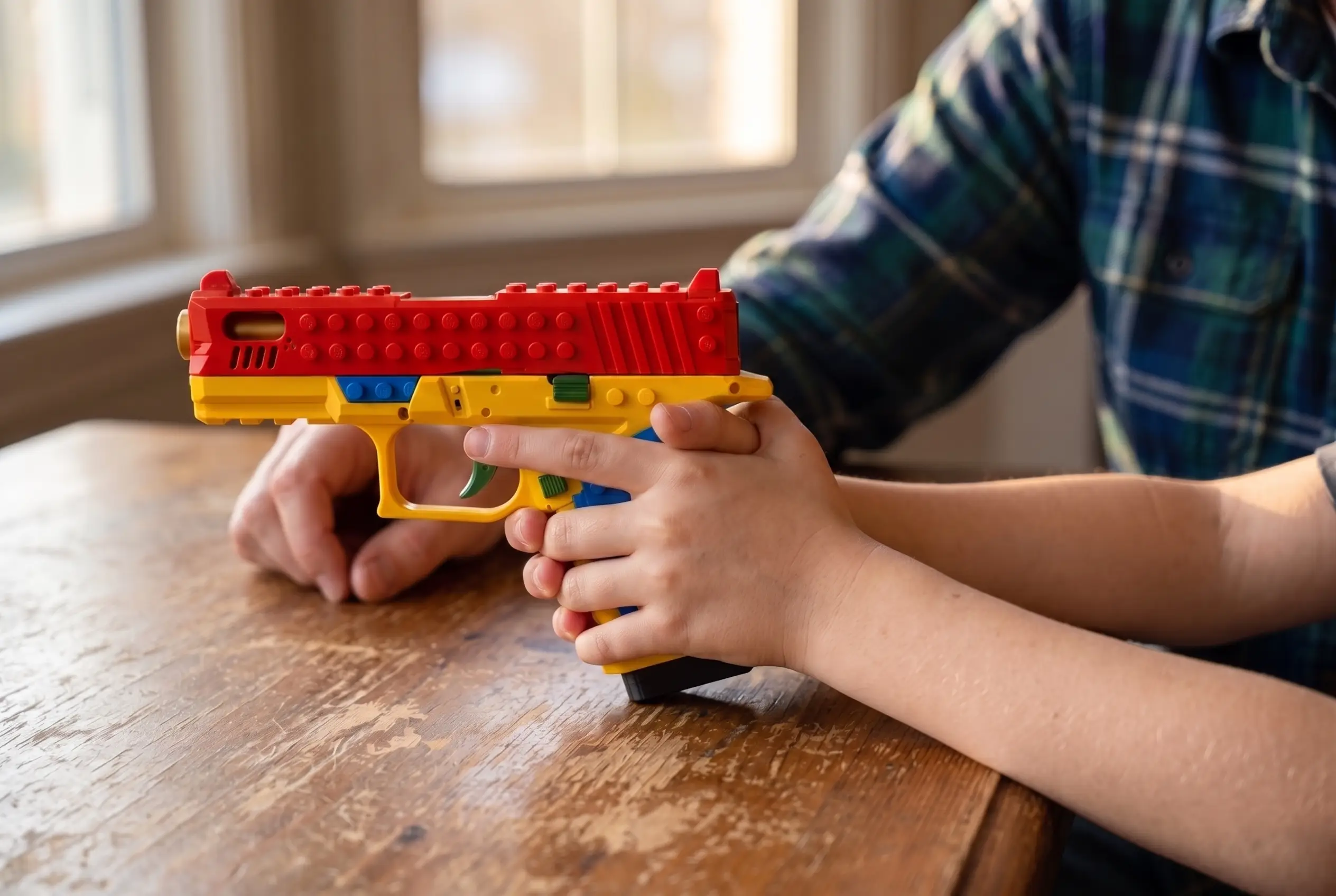
Parents keep reporting the same scene, and I've lived it — two weeks in, at my own table. Somebody picks the thing up carelessly. In our house it was me, on purpose by then. And a small voice says:
"Finger off the trigger, Dad."
That's the product. Not the plastic. That sentence, delivered unprompted by a kid who doesn't know he was taught. I spent a career being told rules don't survive stress. Reps do. Now the reps cost less than a tank of gas and run at a kitchen table.
The questions I'd ask, answered straight
"Isn't it too realistic?" It's the least realistic-looking blaster your kid will ever own — that's deliberate. All the realism lives in the mechanism, where it teaches. None of it lives in the appearance, where it could confuse anyone.
"Won't it make him more obsessed?" The opposite, in every case I've watched. Forbidden fruit feeds obsession; supervised reps make the mystery boring. A kid who has cleared a chamber two hundred times isn't spellbound by the idea anymore. That's the point.
"What age?" Made for about 7–12 with an adult in the room. The reviews run from eight-year-olds running the drill solo to fifteen-year-old grandsons who wouldn't put it down — and a fair number of dads who bought it "for the kids." I'm not judging. Mine spent its first night on my desk.